Henry Moore, Time/Life Screen: Working Model 1952
Henry Moore, Time/Life Screen: Working Model 1952 Audio guide
Transcript
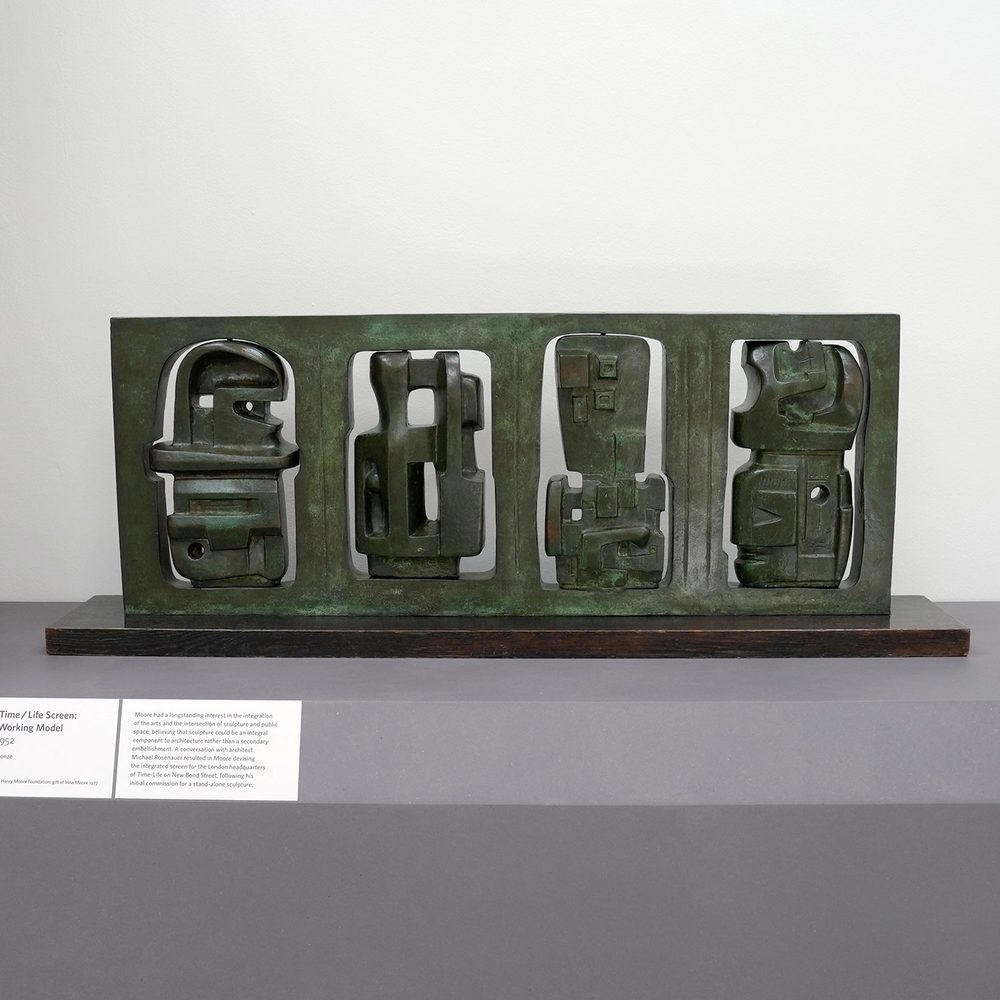
This piece is one of Moore’s designs for a sculpture made in 1952. Titled Time/Life Screen: Working Model, it is situated on the back wall of the gallery, to the right of the large display case. It’s positioned above waist height on a large grey shelf. It can only be viewed from the front but is not behind an acrylic cover, so we can get quite close.
It’s a long rectangular piece, cast in bronze. It’s over a metre long, and just under half a metre high. The depth is only twenty centimetres wide, and so the work has a flattened appearance. It sits solidly in a horizontal orientation on a long, rectangular wooden base on the shelf.
Although in bronze, the colour is unusual. It’s dark and muddy green like verdigris or algae. In places it’s mottled. The surface of the bronze seems to have oxidised to its green colour as a result of its environment and Moore’s intentions.
The piece is like a picture frame, with four rectangular window spaces inside, with rounded edges. Each one of these contains an individual bronze sculpture. Together they form a kind of screen.
The four sculptures within are abstract and all different. It’s not clear what they represent. Could they be faces, gargoyles, or machinery with moving parts?
From left to right, the first sculpture is chunky and squashed into its opening.
It could be a head and shoulders in profile, with a rounded helmet. It also suggests tools and machinery, perhaps a ratchet or a spanner.
The next frame is a vertical and horizontal structure with holes. It suggests metal moving parts, such as a piston.
The third window is reminiscent of a carved totem figure with a large flat head, facing us. Its geometrical sections are again reminiscent of mechanical parts.
The final piece on the right, seems constricted within its frame. Again in profile it echoes the first sculpture. In this way, the two sculptures which bookend the screen could be faces looking inwards.
The sculptures within the screen appear like silhouettes, revealing negative spaces of the white wall behind. This is a playful element: a sense of a puzzle or moving parts.
Indeed, when Moore made these pieces, they were originally designed to pivot within the frame. The work was probably made on this scale so that he could experiment with how this would work practically. In the current position we cannot touch or rotate the pieces, but we are aware of each being an individual sculpture within the larger body of the screen.
In this period, Moore gained greater recognition, being awarded private and public commissions. He worked closely with architects of that time, such as Michael Rosenauer, wanting to make his work integral to the building design, rather than an add-on.
Listen as Moore describes his original, ambitious plan for the Time/Life Screen:
Henry Moore: “Here’s the Time/Life Screen. […] They were intended to be put on turnable bases so that one could have turned them individually into different positions, say at the first of every month. But this was found impractical because the, each of these blocks weighs four or five tons, and it was thought to be a danger to the public […] though I think it’s still a good idea and should be […] to get that advantage of not always seeing the same view of a piece of sculpture.”
– The final work in Portland stone can still be seen from New Bond Street, on the third-floor façade of Time & Life Building in London.
[Music]
Exhibition
Find out more about The Art and Life of Henry Moore, an exhibition that introduces the three key themes in Moore’s work – mother and child, reclining figure, and internal/external forms – and traces the artist’s journey from student to internationally recognised artist.

Exhibition
The Art and Life of Henry Moore
Buy an annual ticket
Audio guide
Discover more works in the exhibition with our audio guide.
Created in collaboration with artist Sally Booth, this audio guide was developed with visually impaired visitors in mind, and can be enjoyed by anyone. The tracks feature descriptions of eight sculpture highlights, as well as an introduction to the exhibition. You can also access the guide by scanning the QR codes in the gallery.
The audio clips of Moore speaking which accompany the descriptions are extracts from the artist’s interviews with John Hedgecoe, which took place at Perry Green between 1967 and 1985.
Audio guide for The Art and Life of Henry Moore

An introduction to The Art and Life of Henry Moore and to the Sheep Field Barn Gallery at Henry Moore Studios & Gardens, where the exhibition is on display.
Transcript for Audio guide for The Art and Life of Henry Moore
Hello and welcome to the Sheep Field Barn Gallery at Henry Moore Studios & Gardens.
Situated in the grounds of Perry Green is a large barn with vertical wooden cladding and an asymmetrical pitched roof.
As you enter through the sliding door, a large, double-height airy white space opens up. In this atrium on your left are enlarged black and white photographs of Henry Moore in action in his studio with mallets, chisels and large works-in-progress.
As you go through the corridor space ahead, there are Henry Moore posters in an alcove on the left, an accessible lift, a staircase leading to the upstairs gallery and, on the right, a low wooden bench. There is also a small room to your right, in which a number of BBC documentaries of Moore at work are playing on a loop. In this space there are benches where you can sit and watch or listen to the films.
From here, a bright open-plan gallery draws you in.
The space opens up like a vast aircraft hangar. It’s flooded with natural light shining in through eight skylights from the pitched roof above.
The space is painted soft white and pale grey with grey flooring throughout, clean lines and is spare with a modernist feel. There are no partitions, so there is an uninterrupted view, punctuated by clusters of works on plinths and in display cases around the room.
In the space there are around eighty sculptures. Some are presented in groups in display cases, some with acrylic covers and some without, while some larger works stand alone. There are also four large display cabinets: one on each wall. Here, smaller sculptures and maquettes (small models for larger works) are displayed in rows on shelves.
Many of the exhibits can be encountered from all sides or we can get very close, but we are not able to touch any of the works.
The exhibition takes us chronologically through four chapters of Henry Moore’s long and active life:
- Exploring ideas and materials (1922 to 1939)
- His work as a civic artist (1940 to 1959)
- Monumental presence (1960 to 1976)
- Enduring forms (1977 to 1986)
Our tour will highlight eight sculptures in the exhibition which cover the wide range of Moore’s development and working practices. Each track lasts between three and five minutes.
As you enter the gallery, you will find the first chapter on the left and if you follow the display clockwise around the room, you will get to the chapters two and three at the back of the gallery, finishing at chapter four on the right, back near the entrance. This audio description follows chronologically. However please feel free to meander around the space, encountering the works in any order you choose.
Each chapter comprises an introduction, a selection of sculptures on plinths, a wall display case with smaller sculptures and maquettes, plus reproductions of archive material including photographs, press cuttings and exhibition catalogues, displayed on the wall.
There is also a small video screen mounted on one wall, showing silent film footage of life and work at Perry Green made by Frank Farnham, Moore’s foreman, and his son John, one of Moore’s assistants. Filmed in the mid-1960s, the recordings on display show activity in and around the Plastic Studio, where Moore and his assistants worked on his monumental sculptures.
[Music]
Henry Moore, Woman with Upraised Arms 1924-25

Audio description of Henry Moore’s Woman with Upraised Arms, a limestone sculpture just under half a metre tall.
Transcript for Henry Moore, Woman with Upraised Arms 1924-25
Our description starts at the first display case we encounter near the entrance to the gallery. Woman with Upraised Arms is a sculpture carved from one solid piece of Hopton Wood limestone.
At waist height on a grey plinth, she’s placed on a small wooden base, between two other sculptures, all under an acrylic cover.
This carving, just under half a metre high, is a figure of a woman from waist up. She’s stretching her arms, above her head, as if she’s just got out of bed. It’s a really long, strong stretch.
She cranes her head upwards, her short neck hunched into her shoulders, as if taking her first breath. Her arms are chunky but her hands clasp each other gently, aloft. The features on her face are suggested by simple cuts into the stone for eyes, nostrils and mouth. Her breasts are softly rendered simplified mounds, almost implied. It seems intimate, as if she’s been caught in a moment.
The stone is a warm greyish white in colour. There are little flecks on the stone where Moore would have used a tool to scratch in texture.
When encountered from the opposite side, we are more aware of the hole made by the outline of the arms overhead: it reveals the vista of the gallery entrance beyond. From this angle we get a real sense of the strain, the muscular action of the stretch releasing tension, the suggestion of the spine and the tresses of long hair flowing down the back. From the side, the belly protrudes and the neck cranes forward.
Made between 1924 and 1925, the work demonstrates Moore’s interest in direct carving and exploring the idea of ‘truth to materials’. This would have been one of Moore’s first experiments with piercing through the stone block to create openings or holes through the material, which became a recurring theme throughout his practice.
In the following recording, Moore reflects on his desire to explore three-dimensional form:
Henry Moore: “I mean, you have to have a real desire to make three-dimensional form […]. What I mean is, you could make, by just copying, a telegraph pole […] it’s like a table leg or something. Whereas this, in which those breasts, and the hands, and then the division between those, that really needs – or needed from me at that time – the desire to make a three-dimensional form that was special, even going through the arms of this girl figure here. That was the beginning of the holes period.”
[Music]
Henry Moore, Square Form 1934

Audio description of Henry Moore’s Square Form, a solid block of stone with sections cut away, about the size of a human head.
Transcript for Henry Moore, Square Form 1934
Further into the gallery space on the left is a rectangular display case, which is sideways on and contains two sculptures. The work we will be describing here is on the left and is titled Square Form. It’s made of one solid block of stone.
The work is displayed on a plinth at waist height and is just larger than a human head in scale. It sits on a dark wooden base. The shape is squarish, but its corners are filed to form rounded edges.
The first impression is of solidity and heaviness. Made from a block of Burgundy limestone it has a warm oatmeal colour with a pinkish tinge. The surface appears smooth and is highly polished but pockmarked in places with little indentations.
On closer inspection, this sculpture presents a more complex interpretation. Is this piece abstract or figurative? In places Moore has completely cut away sections of stone transforming it from a simple square. Peering over the top of the sculpture there is a shallow semicircle scooped out. On the front there are geometric shapes carved into the stone. He has incised some very precise vertical and horizontal lines into the surface. Here, Moore seems to be combining sculpture and drawing. From the front, these can be read as facial features: two fish-like shapes, like eyes, are drawn one above the other in the top right and a circle – perhaps an ear? – at the bottom left, suggesting a head profile. This is further reinforced by a long incision carved out low-down on the side. Could this be a mouth?
The rounded edges and the sharp lines also suggest armour, a helmet.
The back of the sculpture is smooth and flat. The only feature is a thin, vertical rectangular shape carved out at the bottom like a shallow doorway, with a vertical slot inside.
This sculpture, made between the First and Second World Wars, is an example of Moore’s experimentation with abstraction, but his work still reminds us of the human form. Moore at this time would have been fully aware of the work of his contemporaries: Ben Nicholson, Naum Gabo, Constantin Brâncuși, all of whom were exploring abstraction through their work.
Listen to Moore as he describes some of the challenges of direct carving:
Henry Moore: “One had this belief in direct stone carving, in direct carving, and in trying to keep the material keep its own quality and its own character […]. One was frightened to make the material do what you wanted it to, because you didn’t want to force it beyond its, what was its obvious, stoniness […] often the forms were all buried inside each other. The heads were given no necks. And even in some of my early ones you’ll find that there’s no neck, because one was frightened to weaken the stone […]. The material was being more powerful than you.”
[Music]
Henry Moore, Family Group 1945

Audio description of Henry Moore’s Family Group, a small bronze sculpture with two seated figures holding a child between them.
Transcript for Henry Moore, Family Group 1945
At the far end of the gallery, is a very large, dark grey wall-mounted display case. Inside there are a number of small sculptures, predominantly featuring a mother and child or family groups.
This work titled Family Group, made in 1945, is at the top shelf, second from the left. It’s nestled between two other small terracotta sculptures, in the same series. They are displayed roughly at head height and although behind an acrylic cover we can get quite close, but only to the front of the sculpture.
Two figures, perhaps a mother and father, are facing towards us. They are seated very close together on a low bench, holding a young child between them. The scale of the sculpture is small, roughly the size of a human head. It could be held in two large hands but being bronze, it would be quite heavy. The plinth that the bench rests on is part of the sculpture and is also rendered in bronze.
The mother, on the left, wears a long skirt which drapes over her legs. She is supporting the weight of the young toddler, with its legs resting on the father’s arms, to the right. It seems to connect the two figures forming a bridge between them.
The adults have strong shoulders and long limbs. They contrast with the child, which seems to wriggle in their arms.
The limbs of the figures are intertwined, protecting and cradling the child between them. The knees of the parents seem to almost touch, emphasising the close bond. It’s an intimate scene depicting a close, caring family.
Although definitely recognisable as figures, the style of the sculpture uses very simplified forms. The heads are not portraits. They are small and round with only a reference to facial features, for example pin-prick eyes.
The father’s head suggests a heart-shape, with an indentation at the top.
This bronze sculpture is predominantly dark brown or burnt umber in appearance but is not uniform in colour. It has a shiny and smooth finish. Where it has been highly polished and reflects the light, the colours are brighter, almost golden and glistening. The light picks up the folds of the mother’s skirt, as it stretches over her legs. This contrasts with the reddish terracotta sculptures either side.
These small sculptures would have been maquettes, which are small prototypes or 3D models. Moore often made maquettes to try out his ideas for larger sculptures. Unlike his earlier direct carvings, he could use a variety of modelling materials for these family groups, such as wax or plaster, which could be modelled, incised and carved and then cast in bronze.
This Family Group was one of many that Moore made in the 1940s, shortly after his move from London to Perry Green, but the seed for the idea came from an earlier commission.
Henry Moore: “I think the Family Group idea really crystallised when Henry Morris, the Director of Education of Cambridgeshire […] did Impington Village College. […] He asked me if I would do a sculpture, and because Impington Village College was going to be used in the evenings for adult education as well, and for parents […] it became my idea of connecting the parents and the children. And I think that the first Family Group idea, seed for it, came in that time, in 1935-36.”
[Music]
Henry Moore, Working Model for Upright Internal/External Form 1951

Audio description of a mid-size sculpture by Henry Moore, which references armour and the mother and child theme.
Transcript for Henry Moore, Working Model for Upright Internal/External Form 1951
Just a little back from the display case, this sculpture sits on a low plinth. It’s encased in acrylic, so it can be viewed from all sides. It’s just over half a metre tall and reaches from waist height to head height.
Its title is Working Model for Upright Internal/External Form, made in 1951.
The sculpture stands on a squarish brown wooden base. It’s tall, thin and vertical, like an elongated lozenge shape. It seems to have an outer casing with organic forms inside. On our first encounter, it could be stone but is in fact made from plaster. The colour, a creamy grey white makes it appear like bone or ivory. The surface has been polished to a soft sheen with greyish scratch marks drawn in, both inside and out.
There is a suggestion that the outer shell is protection or armour for something inside.
The front is open, with a strip across near the top, like a sandal strap. It creates the impression of two cavities within. As we approach it’s not apparent what this represents. Is it a seed pod or a cocoon? Is it plant form or human form? It could be a foetus inside a womb, a mussel inside a shell, or a baby swaddled in cloth.
Inside the top of the structure is a rounded form, which has been hollowed out, perhaps suggesting a head or some other natural form. It has a small protuberance at the top with a hole through it.
Extending down from the head is an extruded form, like a long stalk or sausage shape. At the bottom it becomes bulbous with a long slit through it, like an eye of a large needle.
Inside the cavity there is a slightly pinky, fleshy tone.
If we go round to the back of the sculpture, the surface is much flatter and smoother. Overall, it has a long rounded oblong shape, suggesting a mummy or a sarcophagus.
Moore purposely made his sculptures open to interpretation. They are both abstract and reference natural forms.
This sculpture is one of many where he experimented with combining the internal and the external.
Moore made a number of smaller works so he could still handle them, pick them up and view them from all sides. This one made in plaster would have been a lighter material than stone, wood or bronze.
This is one of Moore’s mid-size working models which he eventually made on a much larger scale.
One of his monumental bronze works, based on this series, can be seen in the grounds outside the gallery.
Listen as Moore describes how this form explores the idea of protection:
Henry Moore: “This is the Large Upright Interior/Exterior sculpture, which I did other sculptures based on this form idea of one form being protected by another one. Some of the Helmets from 1939, in which the interior of the helmet is really a figure, and the outside of it is like the armour that one might be protected in battle. But also, in my mind was this, the Mother and Child idea too, and of the birth in an embryo. So that all these things are connected in this Interior/Exterior idea.”
[Music]
Henry Moore, Time/Life Screen: Working Model 1952

Audio description of a rectangular bronze screen by Henry Moore, in which four individual bronze sections pivot.
Transcript for Henry Moore, Time/Life Screen: Working Model 1952
This piece is one of Moore’s designs for a sculpture made in 1952. Titled Time/Life Screen: Working Model, it is situated on the back wall of the gallery, to the right of the large display case. It’s positioned above waist height on a large grey shelf. It can only be viewed from the front but is not behind an acrylic cover, so we can get quite close.
It’s a long rectangular piece, cast in bronze. It’s over a metre long, and just under half a metre high. The depth is only twenty centimetres wide, and so the work has a flattened appearance. It sits solidly in a horizontal orientation on a long, rectangular wooden base on the shelf.
Although in bronze, the colour is unusual. It’s dark and muddy green like verdigris or algae. In places it’s mottled. The surface of the bronze seems to have oxidised to its green colour as a result of its environment and Moore’s intentions.
The piece is like a picture frame, with four rectangular window spaces inside, with rounded edges. Each one of these contains an individual bronze sculpture. Together they form a kind of screen.
The four sculptures within are abstract and all different. It’s not clear what they represent. Could they be faces, gargoyles, or machinery with moving parts?
From left to right, the first sculpture is chunky and squashed into its opening.
It could be a head and shoulders in profile, with a rounded helmet. It also suggests tools and machinery, perhaps a ratchet or a spanner.
The next frame is a vertical and horizontal structure with holes. It suggests metal moving parts, such as a piston.
The third window is reminiscent of a carved totem figure with a large flat head, facing us. Its geometrical sections are again reminiscent of mechanical parts.
The final piece on the right, seems constricted within its frame. Again in profile it echoes the first sculpture. In this way, the two sculptures which bookend the screen could be faces looking inwards.
The sculptures within the screen appear like silhouettes, revealing negative spaces of the white wall behind. This is a playful element: a sense of a puzzle or moving parts.
Indeed, when Moore made these pieces, they were originally designed to pivot within the frame. The work was probably made on this scale so that he could experiment with how this would work practically. In the current position we cannot touch or rotate the pieces, but we are aware of each being an individual sculpture within the larger body of the screen.
In this period, Moore gained greater recognition, being awarded private and public commissions. He worked closely with architects of that time, such as Michael Rosenauer, wanting to make his work integral to the building design, rather than an add-on.
Listen as Moore describes his original, ambitious plan for the Time/Life Screen:
Henry Moore: “Here’s the Time/Life Screen. […] They were intended to be put on turnable bases so that one could have turned them individually into different positions, say at the first of every month. But this was found impractical because the, each of these blocks weighs four or five tons, and it was thought to be a danger to the public […] though I think it’s still a good idea and should be […] to get that advantage of not always seeing the same view of a piece of sculpture.”
– The final work in Portland stone can still be seen from New Bond Street, on the third-floor façade of Time & Life Building in London.
[Music]
Henry Moore, Three Way Piece No.1: Points 1964-65

Audio description of a large, abstract plaster sculpture by Henry Moore, which resembles an oversized vertebra or tooth.
Transcript for Henry Moore, Three Way Piece No.1: Points 1964-65
This piece is situated at the far, right-hand corner, towards the back of the gallery. It’s the largest sculpture in the exhibition and draws the visitor in from the entrance.
The work, titled Three Way Piece No.1: Points 1964-65, stands taller than a person at nearly two-metres high and over two-metres wide. It is presented on a large circular grey plinth on the ground, about three metres in diameter. It’s not covered by an acrylic case, so we can explore it from all angles.
Our first impressions on encountering the work, apart from its vastness, are “What can it be?” and “What is it made of?”
This abstract sculpture is a warm creamy white in colour, perhaps like stone, bone or ivory but is in fact plaster. It’s textured all over with scratch marks drawn-in and dark brown flecks which cover the surface. Unlike our expectation of plaster being dry, the surface has a soft sheen and reflects the light above: this effect has been created by a shellac coating, to which some colour has been added.
The top of the sculpture is curvy and undulating. At the bottom, three legs taper down to points, balancing the sculpture on the plinth.
The organic forms have lumps and bumps like a featureless head, a ridge like a spine and a large rump. There is no definite front or back to the sculpture. Each viewpoint is different and we get a sense of movement as we move around the piece.
The shape and colour of this solid mass suggest many organic forms. Could it be an enormous tooth like a molar, a woolly mammoth, a giant dinosaur vertebra, a bison or even a polar bear? It’s certainly such a size.
This monumental piece is one of a selection made by Moore in his specially built studio in Perry Green. Here, he was able to build large wooden armatures to construct the sculptures that would later have been covered in scrim and plaster. In the following recording, Moore reflects on the practicalities and limitations of working at scale:
Henry Moore: “This is the three-piece sculpture. It was meant to be possible to turn it over, put it in three or four different positions. It could have stood not in the way it is now, but on its side, over the other way. It was this attempt to show underneath views, top views, side views, bottom views, everything, and that’s why it’s called Three Way sculpture.
[…] Where I made a mistake was, I made the sculpture too big […] to show it one way and turn it another way: it should’ve been only half the size, but in plaster one could do it. But one hadn’t realised that by the time it came round. We all make mistakes and we can’t help it.”
[Music]
Henry Moore, Working Model for Oval with Points 1968-69

Audio description of an abstract oval sculpture made of bronze, inside which two points stretch out towards each other, but never quite meet.
Transcript for Henry Moore, Working Model for Oval with Points 1968-69
In the middle of the gallery, to the right-hand side, this large sculpture stands on a dark, square bronze base, set on a waist-high plinth. Made between 1968 and 1969, this piece is titled Working Model for Oval with Points.
It is over a metre high, nearly a metre wide and just over half a metre in depth. The top is higher than head height. It’s not in a display case and you can move all around the work.
The outside shape is roughly an oval, but it is not perfectly symmetrical. Inside the oval shape are two circular holes, one above the other. The one at the bottom is slightly larger: they make a negative space, like a snowman shape, through which we can view the gallery behind.
Encountering the piece from the front it appears more like a figure of eight or a giant pretzel. Made of bronze, the colour is a rich brown, like molten milk chocolate or a caramel. It is highly polished and has a glossy sheen. Although made of metal, the shape seems fluid and silky, and full of movement.
Coming closer, towards the centre, it becomes apparent that the middle section dividing the two holes is not quite complete. There are two spiky points, that do not meet in the middle. They are sharp and potentially dangerous and perhaps take us by surprise, as they are unlike Moore’s usual soft and rounded forms. There is a tension here. The two points seem to be trying to meet but something repels them back.
Although he had earlier rejected classicism, Moore maintained an interest in Renaissance painting and sculptures. It is possible that this work refers to Michaelangelo’s fresco painting The Creation of Adam in the Sistine Chapel, where God and Adam are nearly touching fingers.
Moving around the work, the sides are narrower, the surface of the sculpture at the back is much flatter and very smooth. We also get a different view of the gallery through the two holes from this side.
By the 1960s Moore had spent many decades experimenting with the dynamic three-dimensionality of form created through the use of holes and openings. Using bronze allowed for works to be cast in sections and subsequently welded together to make much larger, stronger structures. The metal’s tensile strength also gave Moore freedom to experiment with these pointed shapes that would have been almost impossible to achieve with direct carving in wood or stone.
In the following recording, he explains why bronze was the ideal medium for this kind of experimentation:
Henry Moore: “I like using plaster as a medium for my bronzes because nobody makes bronze direct in bronze. When people talk about ‘truth to material’ applying to bronze, it doesn’t strictly apply to bronze because the sculptor can’t take a solid piece of bronze and cut it like he can a piece of stone. He has to make it in something else to begin with anyhow.
He may finish it by the final finishing like I do in some of the highly finished and polished sculptures. But the shaping is made in some other material, and therefore you have to work from knowledge and from experience of what you can do. So that this ‘truth to material’ idea – that you make a thing in what it’s going to be finally in – doesn’t apply to bronze, and bronze is a material that is a reproductive material that can do almost anything you like.”
[Music]
Henry Moore, Draped Reclining Figure 1978

Audio description of Henry Moore’s Draped Reclining Figure, a large figurative sculpture carved from marble.
Transcript for Henry Moore, Draped Reclining Figure 1978
Situated near the bottom right of the gallery, the sculpture, Draped Reclining Figure from 1978, rests on a pale plywood base, on a large waist-high, rectangular plinth. It’s not behind an acrylic cover so we can move all around it.
The sculpture is about two metres long and over a metre wide and high. This is one of Moore’s enduring forms, the repeated motif of the reclining figure as subject matter.
The sculpture has been carved from one piece of solid Roman travertine marble. It’s creamy white in colour, like bone or ivory, with a tinge of pale pink.
The naturally occurring striations of the marble form horizontal flecks across the whole sculpture, directly reminding us of the quarry of the stone’s origin.
Each viewpoint of the sculpture shows us a different aspect and impression of the figure.
From one side, she’s reclining but not lying fully flat. Her lower back and torso are firmly grounded on the plinth, but her upper back is raised up as her weight is supported by her bent elbows and forearms.
From the side her head is in profile. It’s quite small in comparison to the rest of her body. The eyes are simplified circles cut out, with a single hole to suggest a pupil. The gaze points outward, like a bird or a lizard, rather than straight ahead. Her forehead and nose seem to run together in one lumpen form and her mouth and lips are just a carved line. Her arms are strong and solid with chunky hands like mittens. The breasts are just suggested gentle curves, sloping away to a concave belly. Her legs are bent at the knee and her feet are firmly planted on the ground, like blocks. Although reclining and relaxed, it’s an active rather than passive pose.
Encountered from behind, the back of her head is flattened with the suggestion of a bun. She has strong sloping shoulders, with her bent elbows and forearms taking her full weight as she reclines.
Moving round to the front, her bent legs are slightly apart and at an angle. The two legs are unified by a long skirt which has been carved and scooped out across the legs to suggest drapery. The folds are full of movement emphasised by gouged out lines and creases.
This figure can offer us different interpretations from each angle. From one side, she seems relaxed but alert: as if ready for action. From another we are aware of her strength. Her expression is also ambiguous, and the stance could remind us of the pose of childbirth.
Henry Moore was in his eighties when he was making this sculpture. As time went on, he needed more help from assistants in order to fabricate his work.
He travelled to Greece, and some of his works reflect an interest in Ancient Greek art. He also sourced marble from a quarry which Michaelangelo had used for his sculptures during the Italian Renaissance. While Moore was aware of this classical lineage, his own work was pushing forward the portrayal of the human form with modern, simplified forms. In the following recording, Moore discusses how his travels to Greece influenced his decision to use drapery:
Henry Moore: “When I went to Greece and saw how the Greeks used drapery to emphasise the tension of the form inside […], and there one has the projections of form inside the knees, the breasts, the shoulders being not blank, but pushing the drapery from the inside outwards, and between these projections, the drapery falls more slackly in folds. And so you emphasise the pressure from inside, and this principle was why I tried out to use drapery myself.”
[Music]