Rustan Söderling: Fire Gazing and Virus Meadow
Rustan Söderling: Fire Gazing and Virus Meadow Audio guide
Transcript
Stop 8.
My name is Rustan Söderling and I’m an artist and filmmaker.
I’m interested in moving image, how narrative shapes how we view history, how we view mythology and in this case, folklore, I suppose. A lot of my work deal with these sorts of sculptural objects or almost collages of objects.
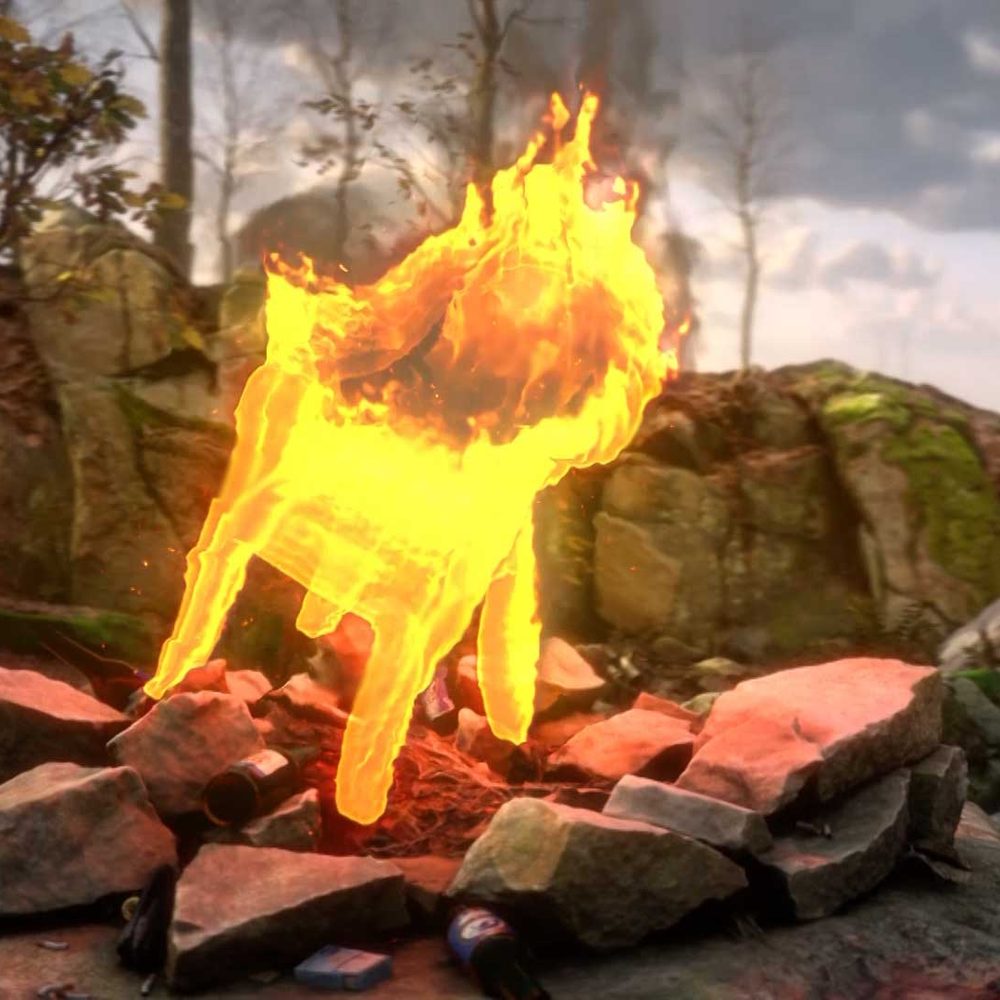
And in Fire Gazing in the fire, there is this all these objects kind of appearing that are meant to kind of represent these different stages in kind of human ingenuity or invention from quite banal things like a toilet to more kind of historical things like the Venus of Willendorf.
In Virus Meadow, what I wanted to do, in a very formal sense, was to make characters that would act as sculptures in a way, as assemblages of objects that would somehow represent their environment. So there’s this kind of character made out of natural objects like twigs and pinecones and moss and fauna and flora. And then there’s this character that’s made out of more kind of contemporary materials, like plastic bottles and crisps, bags and stuff. So they were meant to be kind of moving sculptural objects in a way.
So it goes through a kind of landscape evolution or like a shaping of the landscape by humans, from a kind of pristine environment. And then it comes into more manufactured environments, stone circles, earth mounds. And then it moves through a kind of more medieval environment of church ruins, things like this, and comes to a kind of campsite in the middle of a stone circle. And from that point on, it moves through a tunnel, through kind of modern infrastructure roads, and eventually ends up in a kind of rave in the forest.
I had made a work right before that called The Cadaver Stone, which I filmed in Cornwall. I had done a lot of reading and research on kind of on English folklore, and a lot of the things that I was excited about couldn’t really fit into that film. I really wanted to make a kind of supernatural monster film.
So I wanted to make something that dealt with the Green Man of folklore as a kind of monstrous creature, or the wild man – all over Europe I guess, you have these kinds of foliage heads, I think they’re called. The spew or kind of vomit out a certain sort of foliage out of their mouths within Christianity or within the kind of original purpose, the theories that they represent a kind of subjugation of nature. So nature is below God, let’s say, controlled by God. it’s this kind of chaotic thing, you know, leaves spewing out of a mouth into the world a kind of like life and death cycle. But God is sort of above that.
So I wanted to do something with the Green Man. I couldn’t really figure out how or what, what it should be. And then Covid happened, and I had all this time on my hand and I thought maybe Covid, the Green Man, these kinds of things sort of intertwine to each other. It’s almost like a kind of a virus from nature, a kind of revenge from nature, this kind of virus spewing out of the mouth of the Green Man.
And I came across this photo of swamp gas emerging from a lake, and it’s this kind of green light coming out of a lake. And it looks very mysterious. I came across this theory that swamp gas was probably the origin of the will-o’-the-wisp, which is another kind of folkloric creature or entity. That kind of leads wanderers off track. You know, you follow these lights through the forest and you kind of get lost. So that was kind of the literal germ of the idea to mix these different folkloric creatures.
A kind of technique I use when I make my films is that I, I call it sort of making by proxy. So I make this kind of world like in Virus Meadow. I make this sort of setting and I try to inhabit it, to kind of become part of it in a way. So I will imagine what people in that world would make as a sort of tribes person or something, living inside of a mythology.
I want the work to be, to feel substantial, that you’re basically dipping your toe into this kind of lake, and you feel like there’s this whole ocean beneath you that you can’t see, but you know it’s there. So there’s this kind of substance. You might just have a notion of something much larger. I think that’s what I want people to leave with. Not in a kind of maybe intellectual sense, but in a more visceral sense that you have a visceral reaction to a film or something that lingers with you and stays with you.
This is the end of Stop 8.
Exhibition

Phantasmagoria: Folkloric Sculpture for the Digital Age
15 May – 30 August 2026
Sculpture Galleries
This exhibition brings together a new generation of artists exploring how digital technologies are reshaping what sculpture can be, and how it can be used to tell stories about our past, present, and future.
Audio guide
Discover more works in the exhibition with our audio guide.
Introduction to Phantasmagoria

Curator Sean Ketteringham gives an introduction to the themes explored by the exhibition Phantasmagoria: Folkloric Sculpture for the Digital Age at the Henry Moore Institute.
Transcript for Introduction to Phantasmagoria
Stop 1.
Welcome to Phantasmagoria: Folkloric Sculpture for the Digital Age at the Henry Moore Institute.
Hello, my name is Sean Ketteringham and I’m the curator of this exhibition.
There are in total 13 audio guide stops throughout the galleries, and each track lasts about four to six minutes.
Phantasmagoria brings together ten contemporary artists working across sculpture, installation, video, performance and gaming and they confront how digital technology is reshaping culture today. United by a distinctly sculptural sensibility, the artists share an interest in folklore, twisting traditional structures of storytelling and communal beliefs through digital processes ranging from AI manipulation to 3D printing.
In recent years, folktales, traditional customs and occult practices have returned with new cultural force, even as digital technologies increasingly shape how we see, communicate and imagine. The works presented here show that these tendencies are not opposed and instead reveal that folkloric themes and narrative structures are ever-present in the online and digital spaces that we inhabit daily.
The exhibition’s title refers to a late 18th century form of theatrical spectacle in which projected light, smoke and mechanical devices were used to conjure ghostly apparitions. Later, Karl Marx and Walter Benjamin used the term to describe the seductive illusions of commodity capitalism. Many of the artists in the exhibition are similarly attuned to the enchantments of contemporary technology and the forms of belief and fiction it generates.
Artworks by Nina Davies and Joey Holder, alongside Steph Linn and Philip Speakman engage with conspiracy theories and speculative futures. Sculpture by Isaac Lythgoe and Jürgen Baumann reflect on the collision of artifice, illusion, contemporary technology and mythology. Joe Moss and Most Dismal Swamp capture the chaotic nature of contemporary visual and information economies. Rustan Söderling and Danielle Brathwaite-Shirley turn to the animated natural world and the spectral power of ancestral knowledge.
By emphasising the sculptural qualities of these works, Phantasmagoria explores how digital experience changes our relationship with the world around us. Far from being immaterial, digital technologies – our devices and the server farms which support them – are a physical apparatus and have a vast impact on our wider material world. Sculpture is uniquely well-placed to help us understand such connectivity between our physical, virtual and digital realms.
As you entered the building, you may have seen a bold new artwork displayed on our building’s black granite façade. This is Cazimi by Joey Holder. The work is a collective sigil conceived by Holder to bring together elements from each of the artists exhibited in Phantasmagoria. A cazimi is a celestial event that occurs when a planet appears to pass through the exact heart of the sun in direct motion: a rare alignment understood in astrology as a moment of exceptional clarity and grounded materialisation. The work was completed to mark the Mercury cazimi of 14 May 2026, at 23° Taurus, the moment of the exhibition’s opening. Its three-part triptych structure is historically a devotional form recalling an altarpiece designed to open a threshold between the viewer and a sacred or supernatural realm. Its surface emulates ancient stone suggesting a Mesopotamian tablet, votive object or alchemical diagram.
Please ask an Information Assistant for further details.
And please do not touch the works on display.
This is the end of Stop 1.
Nina Davies: Image Syncers

Nina Davies, an artist working in video with a background in dance, talks about her genre- and artform-spanning project Image Syncers.
Transcript for Nina Davies: Image Syncers
Stop 2.
Hi, my name is Nina Davies and I’m an artist who works primarily in video, but I have a history of being a dancer. So the research subject of a lot of my work is popular dance-based practices or emerging dance-based practices that I see arising in popular culture and online spaces. And I consider these dances as if they were traditional dances of the future.
As part of this show Phantasmagoria, I’m showing my project Image Syncers, which started in 2025. I’m showing three components of this project, which are the moving image work and the hoodies, which are costumes that were used in the film and performances of the work. And they’re turned into sort of sculptural objects installed on the wall with hologram fans coming out of the hoods.
The hoodies are made from a sort of vinyl like material. Each hoodie is a different colour. We have a grey one, a sort of pink hoodie, a pale blue hoodie, and a sort of khaki green and cream coloured hoodie. The faces on the holograms protruding out of the hood. There are faces of the characters who are all different performers who I worked with in Vancouver, Canada. And each face is different. And for each of these films, I worked with the performers to appear as if they looked like they were moving like a deep fake. On the front of the hoodie. There is some text which you can’t quite read, and it is inspired by the way that AI images recreate language and garble it, or make it look like it’s an amalgamation of loads of languages in one.
As well as the hoodies, I’m showing three bags made from a transparent or translucent plastic, so you can see the contents of what’s inside the bag. And inside the bag is some of this material that was used for the hoodies, which is like a vinyl material, and on top of the vinyl material is the sort of sculptural hand props which are used by the performers in the film to appear as if their hands are AI generated. So that would consist of extra fingers or a weird sort of ball of chaotic fingers moving in different directions. And in the backpack, which is the larger of the three bags, there is like a double ended hand sculpture. And inside each of the bags there is an iPhone playing a different film. One of the phones in the smaller, over the shoulder bag is showing a video of one of my performers pretending to be a sort of TikTok live streamer, and to appear as if they look like an AI assistant. We did a lot of face choreography to make it look as if they didn’t quite look real.
Complementing these sorts of sculptural works is my video essay, which is a fictional film. So like with most of my work, I usually look at emerging dance practices that are coming out of social online spaces, like social media platforms like TikTok or video game emote culture. And I usually ask the question of, why are people moving like this today?
When I’m exhibiting my work, I really want them to feel like it’s real. So I really view the sculptural elements of my practice as if they’re artefacts. I want people to be considering these dance practices, not just as fun things that just exist online or as humorous moments in time that will fade away. But I think I really want people to consider how our bodies are part of these sorts of new technological systems, and when they’re introduced into our everyday life, how does that change us?
This is the end of Stop 2.
Isaac Lythgoe: Why can't we remember the future?

Artist Isaac Lythgoe describes his sculpture Why can’t we remember the future? and explains the premise behind the work.
Transcript for Isaac Lythgoe: Why can't we remember the future?
Stop 3.
Hi, I’m Isaac Lythgoe and I’m a sculptor and I live in Paris.
In Phantasmagoria I’m showing four works. Why can’t we remember the future? – the sculpture stands around two metres tall and is made from a combination of materials. From the floor, a pair of high heels in black gloss are made from carved wood, set in these heels or wearing them a pair of crossed cow legs. The cow legs have adornments on the shins as if armour, and these are painted in high gloss, flip tone car paints. As we work up the legs at the top of the legs, a pair of horns appear in carved walnut. These horns also double as a very big croissant, and the walnut has a soft feel to it. Stood on top of what is effectively the pelvis of a rear pair of cow legs or a large pair of wings. The wings are a composite of carbon fibre.
I began the work with a very simple premise, which was a consideration of how blind we are to future events and how hard it is to predict. The work started from the title and a very simple thought experiment which place yourself tomorrow and you wake up and nothing that has ever been made by man exists. You exist, your memories exist. But the world is returned to a state that hasn’t been seen for two hundred thousand years. And then try and assemble this sort of the knowledge of the world. Think about how complex and disparate that knowledge is spread across the world, across all the people who’ve woken up without anything that has ever existed.
I wanted to make a work that felt conscious of how precarious knowledge is, and how detached we are from the making of the current world. How complex is the supply chain to make a croissant? And so I really wanted to make a work about a croissant. And this led me to rural France, where I spend a lot of time where I grew up partially, and the fields and the cattle and the grass and the supply chain for the wheat and the milk and the butter and from the shoes that felt like roads to the cow legs, to the wings, which are made out of cow stomach leather.
The four stomachs of a cow have very four very distinct textures. They go from geodesic to something more like a wheat field. And I really wanted, when making, to have this feeling that there were fields up behind this main cow figure.
This is the end of Stop 3.
Joey Holder: The Woosphere

Joey Holder, an artist interested in how digital culture has shaped our society and belief systems, discusses the large-scale video installations and environments that she creates.
Transcript for Joey Holder: The Woosphere
Stop 4.
Hey, I’m Joey Holder. I’m an artist. I work across lots of different mediums, including video, sculpture, installation, and both on and offline as well. I generally create large scale video installations, creating these environments, these worlds that people can experience.
I’m really interested in the way that digital culture, the internet has completely changed our society, how we relate and how it constructs our belief systems.
And so the work that I’ve produced for this exhibition is called the The Woosphere. And it’s a large-scale video installation, so there are consoles opposite each other, which look a bit like video game arcade consoles. So there’s four of those in the space and the room is covered with digital printed wallpaper and vinyl, so it creates this immersive dark corridor with these screens.
And playing on these screens are four different characters. One of them is Jean Baudrillard, who’s the philosopher that came up with the simulation theory. One of them is an alien intelligence called LAM. There’s a synthetic brain that’s grown in a lab. And finally, Golem, who is from Jewish folklore. And they’re each talking over each other.
And so the concept of The Woosphere comes from an idea called the Noosphere, which was put forward by a French priest called Pierre de Chardin and a Russian geochemist called Vladimir Vernadsky, who basically thought about the Noosphere as a sphere of human consciousness, the sphere of mind.
So the work thinks about where we are in our sphere of consciousness today. And like thinking about how digital networks have transformed our consciousness. So rather than a sphere of unified consciousness, now we live in a very fractured schizophrenic consciousness in terms of the digital realm where there’s lots of conflicting ideas and stories and beliefs that all exist in these clashing perspectives rather than something that’s unified.
The work is black and very neon colours as well, like this mix, and it’s drawing on early internet aesthetics. So 90s internet aesthetics also rave culture, transcendence. It also pulls on new age spirituality, wellness culture, memes and Discordianism as well, which started in the 1950s. And then once the internet became more public in the 1990s, Discordianism was spread through various internet sites and so forth as well.
But it’s basically kind of satire religion in the sense that it takes the mick out of all belief systems and religions and says that any kind of structured dogma or set of rules in a belief system should be joked about and taken apart, because everything is true at the same time everything is nonsense. This kind of nonsense and satire has become very powerful ways of communicating across digital networks, like these really powerful jokes which become monsters.
I often think that I’m creating this sort of ritual architecture as well. So the kind of architecture has this effect. You know, when you walk into a Gothic cathedral or you encounter stone circles or something, the way that that those things are organised has this very powerful effect on your body and your mind. It creates this transcendental state.
I mean, if I think about culture or subculture or transcendental experiences for popular culture, I’m thinking that the last time that we had that was when we went to raves. It seemed like the last collective transcendental protest or something. That has so much power, its lack of cohesion or meaning out of the chaos always comes something else, right? So the chaos is these potentials or becomings or something. So maybe if we are in this chaotic, fragmented state, then there are lots of different timelines or pathways or different realities that can come of this. And perhaps like this moment is this tipping point of those potentials.
Maybe the work is saying, we are in this like sea of nonsense now, but that could be like a really productive space.
This is the end of Stop 4.
Joe Moss: Time Compression

Joe Moss, whose work tackles the increasing pace and overlap in our everyday encounters with fiction, talks about his Time Compression series of laser engravings on cardboard.
Transcript for Joe Moss: Time Compression
Stop 5.
Hi, my name is Joe Moss. I work with sculpture, video and events. I try to think about the increasing pace and overlap in our everyday encounters with fiction. This might be through making videos and breaking the fourth wall through events where something unexpected happens, or through making objects that talk about themselves, like these cardboard works.
I’m showing a series of laser engravings on cardboard. They are small works, around 30cm by 40cm, and they’re framed in extruded aluminium profile.
The engraving is very fine, and through the engraving you can see the corrugation of the cardboard underneath. The cardboard is brown. There’s no painting on the cardboard. There’s no marking on the cardboard. It is simply just engraved noise.
So the images on the cardboard are collected from lots of digital noise, which have found images, images generated from AI, and they’re all composed and processed in Photoshop. So in the details of the work, you can see different textures from different resolutions and file types, as well as occasionally recognised certain images.
I’m interested in how engagement with networks that exchange millions of images simultaneously flatten and complicates culture. It’s sort of a collapse of an overarching worldview, replaced by millions of images and short clips that have different takes on how to have a social culture. And these often disagree. I’m interested not so much in the perspectives themselves, which have long been considered through art, but in the actual frequency and density of these social cultures and how they are presented and distributed. If we zoom out, we might consider this constant buzz of information density to be the new culture, and this has implications on older value systems.
I like to consider these works as the material displaying their own effects on the world. So we consider cardboard to be a detritus like a nothing material or an inanimate object. But if we try to think about all the cardboard in use right now, all the shipments and all the storage is a really active material. And then if we consider all of the important objects that the cardboard hides, all the messages it’s sending and all the meaning contained in those cardboard structures, it starts to become quite a fantastical material.
So the idea was to find imagery on the internet, the digital noise that might also seem like detritus, but is influential over us. And to mark the cardboard with this. So in this way, the physical material that distributes those ideas is marked with those ideas. So it’s a little bit like a feedback loop, but zoomed way out from production to its effects.
And then the frame is made from the physical material that enables the marking of the cardboard. So it’s essentially a physical material that is displaying the noise it creates. And it’s in my mind, it’s a way of being truthful to the material and its effects in the world.
I’m also a trained mosaicist, which has been my day job over the last five years. So there are obvious things that we can consider, like speed of production and the speed of the circulation of ideas. There’s a sort of relationship between those two things, which I think is quite interesting to consider, which is that in Roman times, in order to build new architecture, they would break apart old buildings and render down previous marble sculptures to make lime, and then to create new floors or new architecture they would assemble these bits of the old building and then use this lime to create finer and finer substrates until they had a level surface on which to make a new floor. So when you walk around Rome, you can see these levels and you have a sort of stratigraphic reading of the city as it’s repeatedly built on top of itself. So you have layers of old buildings that make the new.
And in the same way, I think you can consider that that’s something that’s happening with digital culture, but it’s just sped up massively, and it’s harder to read because you don’t have these easy layers to see as you walk around a city. It’s something that we’re still trying to work out how to read.
And so I think in my work, I’m often thinking about the relationship between those things. So between the physical and the digital and the way that despite the fact that it’s speeding up and seems completely different, it’s actually like, it’s just a sort of very intense recycling that’s going to make new structures that we’re sort of yet to truly identify.
The best way to experience the Time Compression series is just to look at it for a while. And there are interesting moments that happen with the legibility of the works where if you stand back, you might see something, and if you move up close, you might see something else. You don’t necessarily need to recognise any images within it, but that process of trying to read a seemingly inanimate thing is the experience that I want you to have, in like a complex culture, that process of attempting to read something that appears that is not doing something but is actually doing something, that’s how I want you to experience it.
This is the end of Stop 5.
Isaac Lythgoe: When everything is new the pleasures are skin deep

Isaac Lythgoe contemplates the balance of components and concepts in this sculpture of a small deer standing on the petals of a large flower.
Transcript for Isaac Lythgoe: When everything is new the pleasures are skin deep
Stop 6.
Hi, I’m Isaac Lythgoe and I’m a sculptor.
In When everything is new the pleasures are skin deep, a small deer stands on the petals of a large flower. The flower is supported on a metal frame that stands on the floor.
I was thinking about Bambi on ice and I was thinking about the wind. The small deer is balanced on the petals of a giant flower and is blowing in the wind, but a piece of cloth has fallen over its eyes, and it’s yet to see or consider that it could possibly be in a moment of peril.
There’s a distinct contrast in this work, a sort of to and from, a balance, a scale between what could be and the enjoyment of present moment. And so this idea of Bambi on ice, who could be ice skating or could be about to fall in a frozen lake, finds itself here in this situation of almost cute, almost terrifying. And as you move around it, the angles distinctly go from rather static to rather inverted, and the Bambi could be falling into the flower, or could just be having fun or blown up in the wind. Technically, that work is very reliant on an internal steel structure and the use of rather complicated composites.
Carbon fibre gives it the stiffness to allow this work to float. And from the flower to articulated stamen, suggests the idea of clamps or restraints that reach out towards the Bambi.
I hope that the works will be cautionary, but alluringly positive, and that there can be something fun and expansive and beautiful to be made going forward. And we don’t have to only make the dystopic terror stories that we hear every day.
This is the end of Stop 6.
Most Dismal Swamp: Scraper

Dane Sutherland, who also works under the name Most Dismal Swamp, discusses Scraper: a video work that presents an internet fever dream where different folklores merge and mix together.
Transcript for Most Dismal Swamp: Scraper
Stop 7.
My name is Dane Sutherland and I also work under the name Most Dismal Swamp. And Most Dismal Swamp is kind of led by me. But also every project picks up a number of different collaborators so that the projects can emerge as kind of video installations or gallery installations, performances, club nights, but also, developing off my own kind of research.
Scraper is a 17-minute video work and they kind of present an internet fever dream almost or nightmare, where different folklores can emerge or older folklores can come together and mix together into this weird nightmare world.
The ones shown in the gallery today for chapters one, two and three consist of, for example, a 17th century chapel hidden in Aberdeen in Scotland. This was a chapel that was built in a house secretly for private religious worship. When this Christian worship was outlawed in the country. And I was very interested in how this kind of space enabled a clandestine or secret ritual practice to remain present and kind of allow people to continue practicing it despite laws or other oppression.
So in working with artists such as Nina Davis, she had a kind of idea to work with characters that were assembling the makeshift masks on their faces, which kind of spoke to elements of building new identities online using technologies such as AI, facial remapping and things like that.
But also there are characters which are more stemmed from my own interest in how the internet is traversed now. So I was quite interested in some of the folkloric terms that come across in internet discourse. For example, maybe pursuing a rabbit hole, falling down a rabbit hole online in your own research or on YouTube. And I was interested in the rabbit holes and rabbit burrows as perhaps being an underused or under recognised folkloric symbol for today.
Rabbits are also characters that possess a knowledge of the underworld, understanding of an underworld and kind of decay, dirt, dirty, dark mechanisms that underlie things. But I was also interested in another side of this, where a burrow is not just a rabbit’s home, but it’s also, a means by which rabbits can be reared for meat and fur industries. So a rabbit’s burrow is something that is built by a farmer to reflect the architecture that the rabbit considers to be its kind of normal, wild home in the wild.
I was interested in exploring this simple algorithmic entity called a web scraper, which can be quite easily designed and built to go out onto the internet and harvest whatever data you can programme it to perceive and gather for you. It can be scraped from web pages or profiles, anything like that. And that quite simple behaviour of being programmed to see some things and not see other things, but then build worlds out of those things that you see was quite interesting to me as a model for behaviour.
I think existing folklore does find its way into Scraper and my work through, for example, the rabbit character that I’ve mentioned before. But likewise, I’m also interested in emerging folklore. So folklore that doesn’t have like a precedent in history. I also have an interest in what we are being told that folklore is or isn’t. So for example, I’m interested in critically evaluating the assumption that things like memes represent folklore and whether they truly do.
And so I think Scraper, I would like to kind of maybe prompt people to ask some of these questions about their understandings and their assumptions about folklore and what constitutes folklore, but maybe also to ask what is the source of folkloric topic as well? Is it something that comes from folk and folk practices, or is it coming from somewhere else, like a more algorithmic, trend focused model?
This is the end of Stop 7.
Rustan Söderling: Fire Gazing and Virus Meadow

Artist and filmmaker Rustan Söderling discusses his interest how narrative shapes how we view history, mythology and folklore.
Transcript for Rustan Söderling: Fire Gazing and Virus Meadow
Stop 8.
My name is Rustan Söderling and I’m an artist and filmmaker.
I’m interested in moving image, how narrative shapes how we view history, how we view mythology and in this case, folklore, I suppose. A lot of my work deal with these sorts of sculptural objects or almost collages of objects.
And in Fire Gazing in the fire, there is this all these objects kind of appearing that are meant to kind of represent these different stages in kind of human ingenuity or invention from quite banal things like a toilet to more kind of historical things like the Venus of Willendorf.
In Virus Meadow, what I wanted to do, in a very formal sense, was to make characters that would act as sculptures in a way, as assemblages of objects that would somehow represent their environment. So there’s this kind of character made out of natural objects like twigs and pinecones and moss and fauna and flora. And then there’s this character that’s made out of more kind of contemporary materials, like plastic bottles and crisps, bags and stuff. So they were meant to be kind of moving sculptural objects in a way.
So it goes through a kind of landscape evolution or like a shaping of the landscape by humans, from a kind of pristine environment. And then it comes into more manufactured environments, stone circles, earth mounds. And then it moves through a kind of more medieval environment of church ruins, things like this, and comes to a kind of campsite in the middle of a stone circle. And from that point on, it moves through a tunnel, through kind of modern infrastructure roads, and eventually ends up in a kind of rave in the forest.
I had made a work right before that called The Cadaver Stone, which I filmed in Cornwall. I had done a lot of reading and research on kind of on English folklore, and a lot of the things that I was excited about couldn’t really fit into that film. I really wanted to make a kind of supernatural monster film.
So I wanted to make something that dealt with the Green Man of folklore as a kind of monstrous creature, or the wild man – all over Europe I guess, you have these kinds of foliage heads, I think they’re called. The spew or kind of vomit out a certain sort of foliage out of their mouths within Christianity or within the kind of original purpose, the theories that they represent a kind of subjugation of nature. So nature is below God, let’s say, controlled by God. it’s this kind of chaotic thing, you know, leaves spewing out of a mouth into the world a kind of like life and death cycle. But God is sort of above that.
So I wanted to do something with the Green Man. I couldn’t really figure out how or what, what it should be. And then Covid happened, and I had all this time on my hand and I thought maybe Covid, the Green Man, these kinds of things sort of intertwine to each other. It’s almost like a kind of a virus from nature, a kind of revenge from nature, this kind of virus spewing out of the mouth of the Green Man.
And I came across this photo of swamp gas emerging from a lake, and it’s this kind of green light coming out of a lake. And it looks very mysterious. I came across this theory that swamp gas was probably the origin of the will-o’-the-wisp, which is another kind of folkloric creature or entity. That kind of leads wanderers off track. You know, you follow these lights through the forest and you kind of get lost. So that was kind of the literal germ of the idea to mix these different folkloric creatures.
A kind of technique I use when I make my films is that I, I call it sort of making by proxy. So I make this kind of world like in Virus Meadow. I make this sort of setting and I try to inhabit it, to kind of become part of it in a way. So I will imagine what people in that world would make as a sort of tribes person or something, living inside of a mythology.
I want the work to be, to feel substantial, that you’re basically dipping your toe into this kind of lake, and you feel like there’s this whole ocean beneath you that you can’t see, but you know it’s there. So there’s this kind of substance. You might just have a notion of something much larger. I think that’s what I want people to leave with. Not in a kind of maybe intellectual sense, but in a more visceral sense that you have a visceral reaction to a film or something that lingers with you and stays with you.
This is the end of Stop 8.
Isaac Lythgoe: The truth is only what we get away with

Isaac Lythgoe considers the reality of sculpture in a post-truth era in this work of a goat leaning on a chair blowing bubble gum.
Transcript for Isaac Lythgoe: The truth is only what we get away with
Stop 9.
Hi, I’m Isaac Lythgoe and I’m a sculptor.
In The truth is only what we get away with, a goat stands with his front two feet on a chair. His head is turned and he’s blowing a large bubble gum. The work is a composite of materials. The hooves are cast aluminium. The body of the goat is fibreglass and pigments and paint. And as we turn around the goat, we see that his skin hinges open and internally reveals a network of pipe and engineered parts. These parts, although they appear metal, like many other parts around the sculpture, they’re in fact plastic and painted in a chrome finish that is often used in prop making. When we come down the goat’s front two feet onto the chair, we see a chair that is made from carved oak and cast aluminium and goat rawhide, which is stretched much like you’d stretch a drum. The goat rawhide has a translucent quality pick through the light.
Texturally, everything in this work is soft. Matte finishes really blur the… it’s hard to determine exactly what materials are what. It came out of the idea that a currency that is sort of spread through culture seems to be an acceptance that not everything is as it seems, and that the area that seems to define politics and culture in a broader sense is this idea of post-truth. And I find it somewhat strange that we call an era of post-truth when we have more resources to fact check anything than ever before. And so I really wanted to make a figure that at once felt present and alive and also told its own lies. It is a goat coyishly blowing, a big bubble gum. And then when you turn around the work, it really reveals itself to not be that at all. It’s roboticised, it’s fabricated. It’s not. It’s an illusion.
This is the end of Stop 9.
Jürgen Baumann: Piggod or the Lernaean Serpent

Jürgen Baumann, who works primarily with casting and vacuum forming, discusses his cathedral-like work on display in Phantasmagoria.
Transcript for Jürgen Baumann: Piggod or the Lernaean Serpent
Stop 10.
Hi, my name is Jürgen Baumann. I work mostly with casting and a rudimentary form of deep drawing, which in English, vacuum forming. And I use different resins and polystyrene or a clear polystyrene glazing as sheets. It’s the same stuff that a lot of packaging is made of. So most of the objects that I create are castings that point back to a lost form or to shapes that have been destroyed or, and discarded. Most of them are eager to overcome their planar existence.
This exhibition, I’m showing two works, the triptych called Piggod or the Lernaean Serpent, and a scraped emergency exit sign. Pig God or the Lernaean serpent, it’s a three-piece deep drawing in a clear polystyrene glazing, reminiscent of a cathedral window set. It is like the ghostly hull of a shape that doesn’t exist anymore. The polystyrene glazing reflects the light and, via its compound curves, distorts the view of what lies behind it. And while forming the polystyrene with heat, it keeps a very high transparency and it is almost impossible to see how the curves develop. So the best indicator is usually the reflections of the light on the surface and their curvatures and bends they move slowly. And I use kind of a formwork underneath that I then use the clear polystyrene glazing on top.
The process is somewhat contradictory because if you want a certain part of the surface to move, that’s not necessarily where you apply the heat. You need to heat the material where it needs to bend, rather than where you want it to bend.
And the relief work, like with the figurative elements, is actually what makes it visible at all. There are parts that show sort of a house. There is a dragon-like figure sticking its many heads through the windows. There’s grinning faces on top and a skewed wall, and distorted animals and probably monsters.
By hanging the three parts next to each other, the space in between becomes formal feature. I quite like that as it leaves out the columns that you would have to imagine.
I’ve long been fascinated by the idea of cathedrals, as the builders have managed to reduce material and thus open up the walls, letting the light in. A certain openness has developed. And I find this quite intriguing to me. As with this heavy stone masonry and the fragile stained glass, somehow they managed to create a space that contains and encompasses and like claim space, and yet is able to be open and let through or let the light in. I wanted them to be massive, like a wall that that you could see through that would distort the whole background.
Digital technologies do not directly play a part in the production of my works, I would say. But many hours of video game playing have informed it. And the flatness of the screen, which, by the movement of the character within the game, starts to convey depth and space, or at least the illusion of it. That has always fascinated me. My father used to have a TV shop where he would sell and repair the old monitors, and I used to spend time there as a kid, and that was just pure magic to me. I somehow still is, at least the old monitors.
And on one hand, I have a love for this immersive storytelling and being an active participant of the game. But still, you never cease to be a slave to the game structure and its respective orders. I mean, you’re always following a given path. And so you could say that I’m attracted to the smooth surfaces of the digital world, but at the same time, I’m repelled by them. I think there is not enough dirt.
This is the end of Stop 10.
Steph Linn and Philip Speakman

Sharing an interest in traditional forms of craft and storytelling, Steph Linn and Philip Speakman’s work recounts the history of Kett’s Rebellion in Norfolk.
Transcript for Steph Linn and Philip Speakman
Stop 11.
Steph: My name is Steph Linn and I’m a sculptor, and my practice is mostly based around the textile industry and specifically about knitting.
Philip: I’m Philip Speakman. I am an artist who mainly works with moving image and performance and writing and generally exploring, but also using storytelling. Working with Steph has been really nice because I think we share certain interests maybe to do with traditional forms of craft or traditional forms of storytelling, but looking at them through, I guess quite a contemporary lens.
Steph: The work that I made in collaboration with Phil is my aspect of it are this kind of large, I think of them almost as like reliquaries. They’re surrounding the screens. And they’re made of bent mild steel, which has been bent by hand, and kind of suspended between the steel is knitted textile, and the textile is mostly made of wool cotton. I tried to use a lot of sheep’s wool because the movement we’re talking about, Kett’s Rebellion is in Norwich, and Norwich has a really rich history of wool textiles, specifically worsted wool. So I tried to use as much of that within these as possible.
They are one and a half metres tall by one metre, and they kind of protrude away from the wall, and they’re almost supposed to surround the screens and give the screens, kind of like a feeling of a body behind them. Because on the screen are people recounting this history of Kett’s Rebellion.
Philip: Three portrait hung screens, each of which has got two different speakers. So there’s kind of six characters, I guess across in the work or six narrators who speak to camera in kind of the way that we recognise from people recording TikToks or Instagram Stories to their own phone screen or something. So kind of replicating that kind of language of social media. And between them, they tell the story of rebellion, which began as a protesting enclosure in Norfolk when land suddenly became more valuable for sheep. The wool that could be produced from that people were dispossessed of the land, which led to a large kind of movement led by this guy, Robert Kett, to protest this enclosure and led to this kind of armed encampment on the hill above Norwich.
And it’s a story that exists in kind of local Norwich folklore. It’s something that I was taught about at school. Like there’s Kett’s Hill in Norwich, sort of just outside Norwich still. So I was interested in this as a history of kind of a particular form of protest that was quite successful for a long time.
But the other element of this story is the way that it ended was to do with, there was a prophecy that began to be spread amongst the rebels which was kind of ambiguous and could be taken as a prophecy of their final victory or prophecy of their doom. And because of this prophecy, they moved off of their high ground, their encampment on Kettle Hill went down into, Dussindale, which is where they were eventually slaughtered. So kind of thinking about this idea of prophecy as this kind of particular type of story that has a purchase on reality because it drives people to do things or because it produces forms of belief.
Steph: I think that knit and wool and textiles also have a lot of relationship to war, to violence, to kind of a lot of the political situations that we’re in, you know, the economy of textiles has driven a lot of things. But yeah, basically combining these two things and kind of putting this tension on the knit to take it away from a feeling of coziness or comfort, and bring it into something that will hopefully make people reconsider the kind of associations with.
I hope people come away understanding and more about the way that we have gotten to where we are in the world and the things that we often take for granted, such as like the concept of an enclosure, are not things that have always existed and are not things that are immutable, and just as easy as something can come about, it can also go away.
Philip: The fact that as much as technologies progress and with that, we might think that we move further away from irrational kind of like beliefs or behaviours like believing in prophecies, that actually these things persist and are reproduced by new technologies. And there are forms of folklore that still get repeated by those in positions of power.
This is the end of Stop 11.
Isaac Lythgoe: Cherish curious cats

Isaac Lythgoe reflects on how the mythologies of planets and the aftermath of the Manhattan Project influenced the making of this sculpture.
Transcript for Isaac Lythgoe: Cherish curious cats
Stop 12.
Hi, I’m Isaac Lythgoe and I’m a sculptor.
In Cherish curious cats, half a sphere is hung back to the wall. The sphere is open, made from carved wood, and within it is housed the head of a dog. The top of the sphere is made from what appears to be a mushroom cloud, and as we come down from the top of the sphere, we find a dog’s head. The dog’s expression is rather wild and his tongue hangs out of his mouth.
The tongue is made from uranium glass. Uranium glass was used widely up until around the sixties, when the procurement acts for the Cold War and the aftermath of the Manhattan Project moved all uranium production towards the making of bombs and away from the making of ceramics. And we can find uranium glass used widely globally in ceramic production up until around this time.
I was looking into the mythologies of planets, and this forms part of a broader series of works which base their form from the myths and the embodiments of the planets. Here I was thinking a lot about Mars and the dog of war. This was made in 2023, towards the start of the Ukraine war.
This is the end of Stop 12.
Danielle Brathwaite-Shirley: PIRATING BLACKNESS

Artist and archivist Danielle Brathwaite-Shirley talks about her work PIRATING BLACKNESS, an interactive video game that analyses the history of slavery and our position within it.
Transcript for Danielle Brathwaite-Shirley: PIRATING BLACKNESS
Stop 13.
Hi, my name is Danielle Brathwaite-Shirley. I’m an artist and archivist that mainly makes work in which the audience is the main medium. This often means creating video game or interactive pieces that require the audience to interact with it before anything happens in this space.
I’m going to be showing PIRATING BLACKNESS, also known as BLACKTRANSSEA.COM. It’s a work that will look like a kind of medium-sized fishing boat, which has been cut in half. It will have a controller box with four buttons and most of the work is in a lo-fi, black-and-white or muted colour palette with highlights of red. And it looks as if it was inspired by 3D graphics in the 1990s.
This work is mainly about the history of slavery and analysing your position within it. So what happens is when you go and play the game, you have an option between picking, if your family history is one that carried people across the oceans or one that were carried across the oceans, and depending on that, you will get a ship and you will be able to go on a kind of adventure with your ship, which is all determined by your family history. Survivability of your ship determines if your family history carried people across the oceans or not. Thus your experience will be completely bespoke depending on who you are.
So I had this friend who’s also an artist called Ebun Sodipo. And I asked her for a picture of her eye. And I started modelling a ship because I wanted to do something about the water. And she was doing stuff about the water at the time. And I was thinking along the lines of if water had a memory, what would it say? And so I wrote this story about the wounds of the ocean, and the ocean having these wounds that remembered everything that happened across them and stored anyone that drowned within them.
And this story slowly started morphing into this game, which I started modelling off my friend’s eye. So I modelled the ship. Then I modelled the ocean off their eye. I modelled the sand. At the time also, I was looking at these online games called ARGs or alternative reality games, which basically are a big mystery that you try and unfold. And so in that I kind of made my own mystery in this game where it opens up saying there’s a file in your computer, it allows you to travel back in time to go through your ancestors’ history of the ocean.
When I think about folklore or my interpretation of folklore, it’s more about, archiving the way in which people did think and the way in which they want to pass information on. And so for me, story is something that I always start with. And when I write stories for my work, they’re always based on a grounding bit of reality, whether that’s the research I’ve done or whether that’s an actual conversation with someone.
And so what the stories are attempting to do is just archive that small bit of research or that small conversation, and blow it out into a larger experience that you can kind of sit within. And that also can hold the people coming to the work, which I think is what kind of folklores do.
I think folklores have a small moral or reason they exist. And they grow over time so that more people can tell them, can be, remember them and also can place themselves within them. So for me, it’s about widening the context of my research or those that I want to archive so that other people’s kind of history and ways of thinking affect it. And they feel responsible for the kind of story being told in front of them.
For me, the most important thing is that each work is kind of a mirror to yourself. And a look into yourself hopefully. So the choices that you make through it are the piece rather than what you see. It’s actually the choices that you make through it and the feelings that you have that you leave with often. I’m hoping you leave with an ‘I’ statement rather than this work was amazing.
I don’t actually care about that, I don’t care if you think it’s beautiful. I don’t care if you or at least that’s not my aim. I don’t want you to leave thinking the work is beautiful. I don’t want you to leave thinking the work is an awe-inspiring work. I want you to leave with an emotional feeling and with an ‘I’ statement. So for me, the best way to experience it is through your own choices, feeling responsible for what you’re seeing and then reflecting on what you did.
This is the end of Stop 13.